Transforming a Hospital: What 7 Months of Digital Reality Taught Me
April 29, 2026
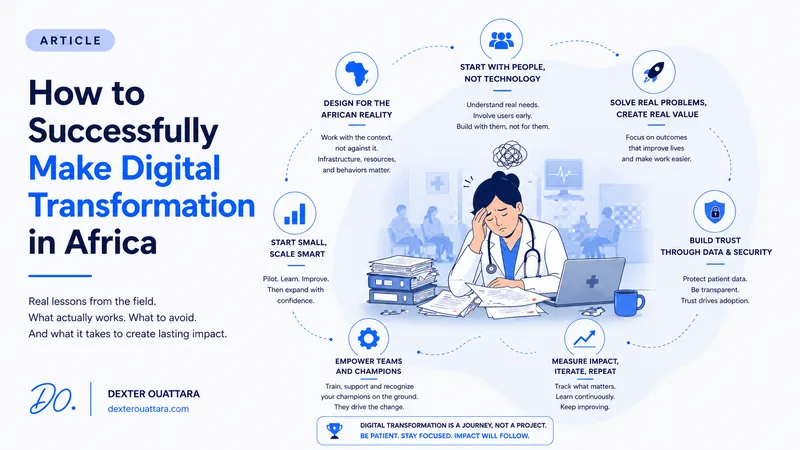
Digital transformation sounds simple on paper.Until you try to do it inside a hospital.
Fsucom Wassakara, in Abidjan.
175 patients per day.
35 years of processes built without technology.
There was no room for error.Only consequences.
This was never about technology
Very quickly, something became obvious.This wasn’t a tech problem.It was a people problem.
Behind every process were individuals who had built their routines over decades, mastered manual systems, and developed their own ways to make things work.
And now, we were coming in with a system.From the cashier who had barely used a computer to the department head who could process files faster than any software, we were not replacing tools. We were challenging identity.
There was no software system. Only repetition.
Before building anything, we had to understand what already existed.
The reality was simple.
Patients arrived and went straight to services. There was no central registration and no shared identity.
Each department operated independently, collecting the same information again, maintaining its own records, and tracking its own activity.
Medical data lived in paper health booklets. Transactions were written in large registers. Every service maintained its own version of the truth.
The same information was written, rewritten, and rewritten again.
It worked.
But behind that “it works” was duplication, inconsistency, delays, and a massive invisible workload.
So we didn’t try to change anything
Our first decision was simple.
Do not change the system. Understand it.
We spent weeks observing how patients moved, how information flowed, where time was lost, and where frustration lived.
And something unexpected happened.
By simply digitizing existing processes, some of them naturally became obsolete.
There was no confrontation. No resistance. Just gradual evolution.
The moment everything could have failed
After seven months, we had something that worked.
Now came the real question. Do we deploy everything at once? No.
This is not a startup. This is a hospital.
If a feature breaks in a startup, you fix it. If a system breaks in a hospital, patients are impacted, staff lose trust, and everything goes back to paper.
So we moved step by step. Controlled and intentional.
One simple idea that changed everything
We started with something simple: a patient identity system.
At the entrance of Fsucom Wassakara, every patient is registered, a digital profile is created, and a QR code is generated.
That QR code becomes the key to everything: consultation, billing, insurance, and follow-up.
One patient. One identity. One system.
This single change addressed the core issue: duplication.
The moment the system proved itself
The cashiers were among the most skeptical.
Before, everything was manual. Registers were filled line by line. Totals were calculated at the end of the day, followed by one to two hours of reconciliation work.
After implementation, transactions were tracked automatically, totals were instantly available, and reconciliation took five minutes.
At first, they thought it was additional work. Then they experienced it.
That’s when adoption started.
Not because we convinced them, but because the system made their work easier.
Resistance is always logical
The insurance department resisted the most.
Their work depended on structure: patient records, validation requests, and reimbursement processes.
In a fragmented system, they had developed their own ways to manage complexity.
Before, it took up to two hours to rebuild and organize files.
After, everything was already structured and instantly accessible.
But for weeks, they didn’t believe it.
Transformation often looks like additional effort until it becomes obvious.
Seven months of doubt
For months, one question kept coming back.
Will this system actually go live? Seven months of skepticism.
Then we launched.
Two months later, more than 10,000 patients had been registered. A unified system was in place, and the impact was visible.
Not because the system was perfect, but because it worked.
The real constraints weren’t in the code
The biggest challenges were not technical.
Data regulations
In Côte d’Ivoire, health data cannot simply be hosted in the cloud. Regulations are strict.
We had to build an on-premise infrastructure, secure it locally, and isolate the network.
Electricity
Even with a relatively stable grid, outages are a reality.One outage means a return to paper. And once teams return to paper, trust is lost.
So we designed for resilience.Since deployment, the system has recorded zero downtime.
This is bigger than one hospital
This project reflects a broader reality.
Healthcare systems remain fragmented. Processes are still manual. Pressure continues to grow.
Digital transformation is not optional. It is necessary.
What this changed for me
Before this project, I thought product was about building solutions.
Now I understand that product is about fitting reality.
Systems don’t fail because they are poorly built. They fail because they don’t match how people actually work.
And here, the reality was simple.
No system. Only repetition.
And now comes the real work
This was just the beginning.
The next step is to scale this system to more hospitals, more patients, and a broader impact.
Once fragmentation is removed, scale becomes possible.
Real innovation is not about adding complexity.
It is about removing repetition.
The Challenge
Fragmented workflows with no central system led to duplicated data, inefficiencies, and heavy manual workload across departments.
Decades of habits and low digital adoption made change management as critical as the technology itself.
The Solution
Introduced a centralized patient identity system with QR codes, creating a single source of truth across all services.
Digitized existing processes without disrupting them, enabling gradual adoption and reducing resistance.
The Results
Reduced reconciliation time from hours to minutes while eliminating data duplication across departments.
Over 10,000 patients onboarded in two months with strong adoption and zero system downtime.
Key Learnings
Digital transformation succeeds when systems adapt to reality, not when reality is forced to adapt to systems.
Removing repetition and building trust matters more than adding complexity or features.
About the Author

Dexter Ouattara
Product Strategist & Advisor with 10+ years helping founders and organizations build scalable digital products.
Want to achieve similar results?
Let's discuss how I can help transform your product strategy and drive meaningful growth.
BOOK A CONSULTATION